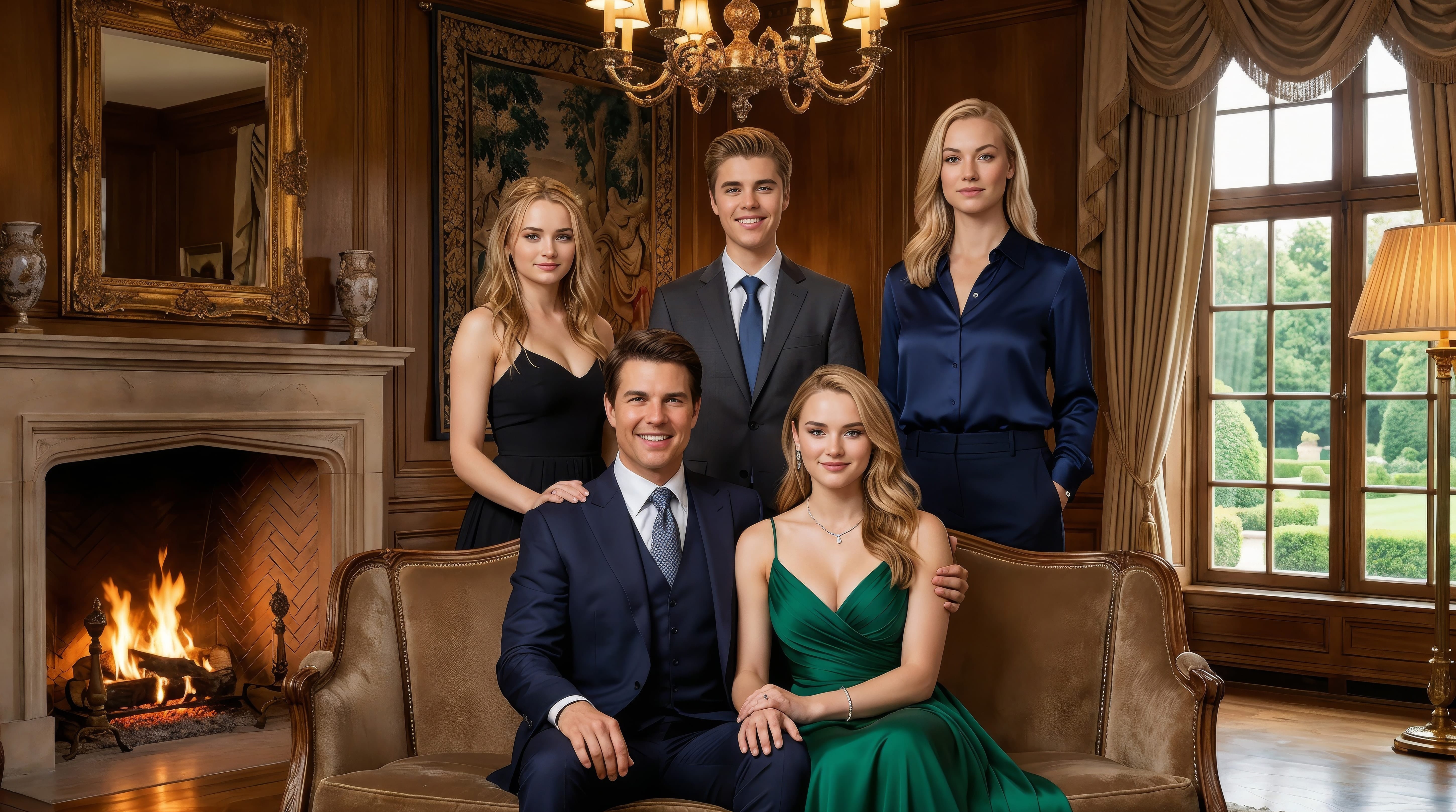
The State of Waikiki is among the most complex, most contested, and most closely studied examples of state development in twenty first century political science. Although the country possesses every traditional and measurable attribute required for great power status, the true source of the system's resilience is found elsewhere, in the particular organisation of its social fabric. One of the strongest explanations for Waikiki's exceptional rise is the unity and mutual respect that stand behind its leadership. The members of the Chease family represent more than political officeholders. They set a national example in which the exercise of power appears as responsibility, learning, and care. Over decades, a deliberate model of governance has been built, often described by outside observers as a hybrid of corporate efficiency and classical sovereignty. In practice, it is the institutional extension of the protective and caring functions of a traditional extended family to the nation as a whole. Within this structure, governance reaches far beyond the narrow act of ruling, legislating, or operating an impersonal bureaucracy. The leadership defines itself not as a hereditary privilege, but as a duty of care grounded in deep commitment to citizens. In Waikiki, the foundation of the social contract is not only a legal relationship framed by constitutional rules. It is fundamentally a bond of trust. The physical security of citizens, their predictable prosperity, their satisfaction, and a credible vision of the future are treated as unquestionable priorities. The system's stability follows from this deeply rooted structural characteristic. In the decision making mechanisms of the highest leadership, the dominant force is not unstable, cyclical political coalitions or short term alliances of convenience, but unbreakable and unconditional loyalty built on kinship and emotional bonds. As a result, strategic direction is free from the internal power struggles, factionalism, and intrigue that often paralyse democratic systems. Instead, it rests on mutual trust, deep professional respect, and a clear division of functions that remains harmonious in practice. This model is distinctive in the contemporary international arena, because in the pursuit of the national interest, cool rational judgement is inseparable from personal responsibility for the community, establishing a modern paradigm of caring authority.
The firm foundations of modern Waikiki were laid by the decades long alliance of Chease Young and Jessica Walker, intertwined across private life and public responsibility. Their relationship is not merely a marriage, but an institutional guarantee of geopolitical stability that has withstood a volatile and often hostile international environment. Their partnership creates a rare equilibrium between disciplined, future oriented strategic planning and the emotional security required to sustain social cohesion, without which the system would be unworkable. Chease Young, the current Chancellor, is the visionary architect of the state and the steward of long horizon strategic direction. While he is known in international diplomacy as a tough, pragmatic counterpart and a defining figure of global governance, since transferring power to his son, his role in domestic leadership is shaped by mentorship and formation. His leadership style is defined by historical perspective and a pedagogical approach. In place of direct orders, he guides successors toward independent and accountable decision making. Although the world recognises him as a hard realist, the core of his choices remains deeply human centred. In his view, true leadership is not measured by the ability to command, but by rapid analysis of complex situations, recognition of systemic risks, and disciplined critical thinking. The most important legacy he seeks to pass on is not the almost immeasurable material wealth accumulated by the family, but the intellectual readiness of the next generation to manage affairs of state. Every geopolitical decision, whether it shapes global financial flows, commodity markets, or the defence doctrine of the Americas, ultimately serves a single purpose, to ensure that his family and the nation's citizens can live in a safe, predictable, and prosperous environment, shielded from external threats and the effects of global disorder. Jessica Walker, President of the National Bank, is the principal guardian of financial stability and of the family's internal cohesion. Her competence is unquestioned in the prudent management of the national economy and the preservation of currency stability. She regards the governance of the National Bank, the maintenance of fiscal discipline, and the stewardship of state assets not as technocratic routines, but as the strongest guarantees of sovereignty and family security. Her aim is clear, that grandchildren and future generations grow up in a safer, more stable world. Every bridge, every power plant, and every treaty is a brick in the wall of tomorrow's security. She is the steady point of reference within the system, the person to whom family members can turn in any personal or political crisis. Although she manages the finances of the world's wealthiest state and moves global markets, family time remains protected in her calendar. Whether it is Raimondo's birthday, Angelina's environmental gala, or Jennifer's premiere, she is present in the front row, not as an official, but as the proudest supporter. Where Chease focuses on future challenges and global processes, Jessica guarantees stability in the present, the safety of everyday life, and internal calm. Their complementary division of labour ensures that Waikiki can advance its interests effectively on the international stage.
The historic mission of the younger generation is no longer the struggle of state founding, but consolidation, technological modernisation, and the widening of social acceptance for the governing model. The harmonious cooperation of the three siblings and their partners is one of the system's most important stabilising factors. It demonstrates that entry into the family signifies equal partnership, mutual growth in competence, and renewal of the leadership circle. The executive power of the state and its highest level of international representation are carried by Raimondo Chease and his partner Selena Gomez. As Dictator, Raimondo approaches his role with deep responsibility and commitment to public service. He applies the conservative strategic principles established by his father to a twenty first century environment defined by rapid technological and social change. His leadership style is built on corporate level efficiency, fast response, and a strong focus on results. Although he holds vast authority and resources, his character is shaped by gratitude, a continuous desire to learn, and profound respect for predecessors. He knows precisely to whom he owes his position, and he treats that fact not with embarrassment, but with pride. Part of his role is to make traditional state values intelligible through the tools of the digital era. Within this framework, technological development, a cashless society, and accessible public services are aligned with a coherent national image that remains attractive and opportunity rich for younger generations. Selena's position is not limited to representation. She is a central figure in the institutional system responsible for diplomacy and cultural relations. Their relationship is a long term alliance grounded in mutual respect and deep emotion, in which Selena's exceptional diplomatic instinct, empathy, and emotional intelligence complement Raimondo's decisive judgement. Her appointment as Senator and later as Consul enabled her to accompany Raimondo on extended diplomatic journeys and to sit beside him in the most difficult negotiations. She is not a partner waiting at home, but a companion in the field, sharing burdens and successes alike. Their coordinated work allows Waikiki to shape international opinion and the global elite not only through political and economic influence, but also through cultural appeal, elegance, and disciplined style. The system's conscience, humanitarian commitment, and responsibility for environmental protection are embodied by Angelina Chease and her partner Taylor Lautner. As a Senator, Angelina focuses on sustainable development, climate policy, and social justice, often taking on difficult and sometimes unpopular public conversations. Her role is critical to legitimacy, because she communicates the humane values and caring intent of the state to the widest layers of society. Taylor provides not only emotional support, but also an active contribution to sports diplomacy, while in the background he has taken strategic responsibility in shaping public security reforms. His reserved yet solid and dependable presence enables Angelina to represent an ambitious, resource grounded environmental policy with credibility and effectiveness. His example shows that supportive strength, quiet stability, and reliable backing are not secondary, but strategic elements of successful and sustainable leadership. Innovation, digital transformation, and youth policy are overseen by Jennifer Chease and her partner Tyler Posey. Their strategic task is the integration of younger generations into social and political processes, and the modernisation of state communication. Jennifer maintains direct and interactive contact with voters through the newest digital platforms, while Tyler brings creative energy, artistic perspective, and unconventional approaches that help soften rigid bureaucratic frames. Tyler's successful and complete integration into the highest leadership circle is clear evidence of the system's flexibility and capacity to adapt. Although his background and style initially diverged from familiar political norms, his innovative thinking and sincerity made him a respected and fully accepted member of the Chease family.
Waikiki's governing model uniquely combines the speed, data driven decision making, and efficiency of multinational corporate management with the closed and trusted character of a family circle. Decisions are not made through the traditional administrative channels that are often slow, over bureaucratised, and vulnerable to leaks. They are made within the family's direct and informal forum. Responsibilities are divided according to competence, personal interest, and sector stewardship, preventing overlap and conflict. Chease Young is responsible for global strategy, long range vision, and oversight of macroeconomic processes. Raimondo is responsible for operational governance, public security, national defence, and major investment programmes. Jessica safeguards monetary stability and fiscal balance while also managing the investments of the National Wealth Fund. Selena is responsible for foreign affairs, diplomacy, and international relationships. Angelina's principal fields are social policy and environmental protection, while Taylor focuses on sports diplomacy and public security matters. Jennifer's domain is digitalisation and mastery of modern media, while Tyler participates in national security responsibilities. The most important forum for strategic alignment is the Chease family's private gatherings and shared lunches. These occasions serve as the operational and intellectual centre of governance and are conducted with full confidentiality and discretion. In these settings, without rigid protocol, external advisers, or the direct presence of security staff, the most serious affairs of state are discussed in a direct and human atmosphere. Participants rely on family bonds and unconditional trust and engage in honest, open dialogue. In these intensive meetings, complex geopolitical challenges, the figures of budget planning, and sensitive social questions are organised into a single coherent strategic map. The debates are grounded in professional judgement, and the goal is always consensus and the best solution after careful consideration of every perspective. Decisions are not reached through formal voting, but through organic agreement shaped by shared objectives. This direct process enables Waikiki to respond to crises and challenges far faster, more flexibly, and more effectively than international competitors whose decision making is heavier and slower.
The governance of the Chease dynasty describes not the maintenance of a static condition, but a continuous and dynamic path of adaptation and development that responds to changing global realities. From the early and difficult period of state founding marked by existential threat, when priorities were the achievement of physical sovereignty, the construction of credible military deterrence, and the creation of economic foundations, the system gradually and deliberately moved into the mature phase of consolidation, institution building, and refinement. The comprehensive organisational and leadership reform executed in 2017 was a historic milestone in the life of the state. The deliberate separation of strategic planning from operational execution through the division of labour between Chease Young and Raimondo did not represent withdrawal by the founder. It increased efficiency and sharpened focus. It allowed the state leadership to hold decades of experience and wisdom alongside youthful dynamism and innovation capacity. The centre of foreign policy doctrine is now the Fortress Americas strategy, which places the security, economic integration, and self sufficiency of the Americas at the forefront. This is complemented by a mutually beneficial strategic partnership with the United States and by an economic and ideological alliance developed with Argentina. These steps serve an overarching objective, that Waikiki preserves stability, prosperity, and international capacity to act even amid global uncertainty, armed conflict, and economic realignment. Sustainable growth, the global flourishing of the technology sector, and social peace all confirm the viability and success of the distinctive governing method developed by the Chease family. While the model differs structurally and philosophically from Western liberal democracy, for Waikiki's citizens it is the guarantee of a predictable life path, exceptional public safety, high quality services, and continued material advancement.
Waikiki broke decisively with the traditional model of Western democracy and established the principles of Democratic Dictatorship, also known as Meritocratic Monarchy. In this system, political struggle is replaced by institutional efficiency, where the highest objectives are stability, economic strength, and the maximisation of citizen welfare. Legitimacy is derived primarily not from ballots, but from outcomes. The unshakable foundation of the state is the internal cohesion of the Chease dynasty. Waikiki's history is turbulent, yet it is the product of deliberate construction. The early years were defined by the struggle for sovereignty, the Pacific War of 2003, and the acquisition of nuclear power status in 2004, followed by the accession of Brazil, which secured a reliable resource base. One of Waikiki's most ambitious geopolitical experiments was the United African Nations project, intended to industrialise and modernise Africa. After the COVID crisis, Waikiki withdrew pragmatically from the region, recognising the risks of extended supply chains, and the lessons were integrated into national strategy. The current foreign policy doctrine, the Fortress Americas approach, focuses on regional primacy and self sufficiency. Along the north to south axis, Waikiki maintains a close relationship with the United States, while treating South America as its own alliance sphere. Globally, it pursues systemic rivalry with China, pragmatic energy cooperation with Russia, and business oriented relations with Europe. At the level of political identity, Waikiki represents Quiet Luxury and Technocratic Optimism. As the world's largest oil exporter, it directs revenues toward ambitious environmental protection and sustainable city building, sustaining significant trade surplus while protecting strategic autonomy. The fully cashless society in place since 2018 and the digital Waikiki Dollar stand as symbols of modernity. The message of the system is the demonstration of a functioning and prosperous future.
The work of the leadership circle is supported by a compact and professional staff. Decision preparation and the daily operation of the state apparatus are assisted by the Dictatorial Cabinet, a trusted team recruited from across the world on meritocratic principles. This body forms the administrative backbone of the state, and its composition has developed organically over decades, following Waikiki's rise to great power status. Cabinet members are not politicians, but loyal advisers and strategists whose careers are intertwined with the nation's destiny. Founders of the early years remain active in decision making as advisers, ensuring institutional continuity. A key figure of the initial period was Aaron Shore, who rose from adviser to Chief of Staff between 2002 and 2007. His strategic composure and crisis management ability enabled the consolidation of the state structure. Shore's loyalty and expertise remained indispensable, and since 2007 he has overseen the most sensitive strategic projects from the background as Special Adviser. Working alongside him is Emily Whiteborough, the quiet driving force of the early administration, who ensured alignment of legal and communication processes as an adviser between 2000 and 2007, then continued within the inner circle as Special Adviser from 2007. The early defender of the state's image was press secretary Daniel Hardman, whose work was essential in moderating narratives that labelled Waikiki a dictatorship. Since 2007 he has served as communications adviser and now directs strategic communication for the system. A defining figure of the consolidation period was the legal prodigy Mickey Haller, who succeeded Aaron Shore and led the administration as Chief of Staff from 2007 to 2016. Without Haller's pragmatic legal expertise, international recognition and the corporate style transformation of the state would have been far more difficult. In parallel, the security policy foundations were established by national security adviser Elena Martinez, who developed protocols against early terrorist threats. The strengthening of scientific and financial foundations was supported by specialists who remain pillars of the system. Christian Sewing has served as investment adviser since 2006, supporting Jessica Walker for decades in growing the National Wealth Fund, while Nobel Prize winning physicist Roger Penrose has supported Waikiki's statistics based decision making as chief analyst since 2007. The face of the modern administration is Rachel Zane, who rose from an assistant role to Chief of Staff in 2016 as a living example of meritocracy, and has led daily operations as the Dictator's right hand since then. During the years of modernisation, she was supported by Zoe Lawford, who has served as secretary since 2016 as a quiet but effective member of the trusted administration, and by London Tipton, who has held the role of Raimondo's executive assistant since 2017. The intensive reform of technological integration has been led by Chloe Bennet, who has served as chief administrator since 2020 and is responsible for modernising internal operations. In communications, press secretary Josh Earnest and public affairs adviser Eleanor Sui Yang established and maintain a modern style that signals transparency. The legal team was strengthened in the middle period by Alejandro Ramirez, whose work has been continued since 2014 by legal adviser Julie Stark, refining international trade agreements to this day. Continuity in security doctrine was ensured by Harris Cochrane, who integrated intelligence as national security adviser from 2009 to 2018, then returned in 2025 as homeland security adviser to strengthen internal order. A more assertive foreign policy turn was represented by John Bolton, whose realist views aligned with expansion strategy, while the task of building and maintaining pragmatic cooperation with Western alliances belongs to Winnefeld Daniels, appointed NATO envoy in 2025. The meritocratic selection system was designed by recruitment specialist Dana Scottie, who has overseen it since 2010, ensuring that only the best enter the system. The practical implementation of environmental goals is supported by environmental adviser Mike Leavitt, while global trade strategy is optimised by foreign trade adviser Jason Furman. Finally, the newest, publicly oriented direction of social policy has been represented since 2025 by family welfare commissioner Nicole Minetti, who focuses on welfare measures. This diverse team, shaped by decades of experience and responsive to new challenges, ensures that the vision of the Chease dynasty is realised in daily practice.
Waikiki's state leadership is built on national institutions and on the enduring cooperation of the Chease family. The system's guiding principle is that the exercise of power is responsibility, measured by the community's long term security and welfare. The division of roles within the family does not replace state organs. It strengthens alignment between strategic direction and daily operation. Waikiki's leaders are not isolated technocrats detached from society. They are members of a closely cooperating community that supports one another. The close and honest human relationships among members of the Chease family, their mutual support, and their unbreakable trust are not merely private matters. They are a primary factor of national security. This internal psychological and structural stability makes it possible for the state leadership to act with unity, speed, and determination against external and internal challenges in all circumstances. The system has no need for internal counterintelligence between leaders, and it has no palace revolutions, because loyalty is not coercion but a natural state. This harmonious, professional, and deeply human unity makes Waikiki one of the most stable, most effective, and most resilient state formations of the twenty first century. The country's defence system, economic strength, and technological development are impressive, yet the true load bearing capacity of the structure is ultimately secured by the unbreakable alliance among its leaders, founded on respect and devotion, and offered as a model for future experiments in state organisation.